Contents
The article was originally published online in 2018 by Lederne (the Danish Association of Managers and Executives). It was lightly updated in 2026.
All the leaders I have helped develop their talent for leadership have been highly skilled. But as a rule they have also had a blind spot, because all people do.
I have therefore made it my job to help leaders get a better view, so they know what to pay attention to in order to become a successful leader.
On their development journey, leaders need to improve their ability to observe:
- Results – including: what is a result for a leader, and which results do you need in order to succeed?
- Relationships with other people – including: how should you approach relationships in order to achieve the leadership results you need to achieve?
In this article I focus on the Complete Leader Compass. It is based on five types of results that leaders need. You will also gain insight into how to engage in relationships with other people in order to achieve the leadership results you need.
Knowing your blind spot is good for your career
Some leadership development consultants say that as a leader you should stick to focusing on what you are good at and not spend energy on what you are not good at. I disagree, because if a leader, for example, has the blind spot that he talks down to and humiliates his employees, shouldn’t we work on that?
Should we instead choose to develop only this leader’s strengths, which could, for example, be clear communication – “calling a spade a spade” – and taking responsibility – “not letting anything fall between the cracks”? My experience is that this leader does not get much better from developing the competences he is already good at, but he will have a more successful career by focusing on his “blind spot”.
Think of John Steinbeck’s novel “The Grapes of Wrath”. Two fathers sit discussing their children, and one father says: “You’ll never get a racehorse out of a pig”, to which the other, more broad-minded father replies: “No, but you can get a fast pig out of it.” When I work with leaders, they all have many strong leadership competences where they are “a racehorse”.
In other words, they are very good at a whole lot of the things you need to be good at as a leader. But on top of that they also have “a pig”. And it is always this pig they trip over, and which is their Achilles’ heel. At best, the pig means they are not promoted, and at worst they lose their job.
Examples of pigs that trip leaders up:
- Walks ahead alone – doesn’t bring the team along
- Keeps wanting to be the best employee
- Purely professional focus – the grey eminence over in the corner
- Is challenged by, and loses the battles to, their own employees
- Outbursts of anger and mood swings
- Gets stressed by not having demands made and boundaries set
- Overlooked and invisible – doesn’t sell their department internally
- Loses negotiations – finds it hard to convince other managers and colleagues
- Poor or no relationship with their own manager
- Doesn’t understand the political game
- Conflicts and high sickness absence among my own employees
- Finds it hard to function in a flat and informal organisation
- Zigzags and struggles with long-term focus
- Gives in to colleagues who behave aggressively and threateningly
- Puts off dealing with conflicts until “tomorrow”
- Becomes jealous of their own most capable employees
The examples of pigs above don’t look pleasant, but remember that as a leader you usually only have one pig. Remember, too, that the one pig you have simply needs to be turned into a fast pig, and then all your racehorses will come into their own much more easily.
Allow me to show you what a leader needs to be able to do
It is normal that, as a leader, you got the job because of your talent and your ambition. As a leader, though, you need to be able to do so much more, and often something quite different, than what lies in your talent and your ambition.
You may be one of your company’s best salespeople, an ace at financial analysis and both visionary and methodical when it comes to strategic planning, and if you are also ambitious, you are hard to stop; of course you should be a leader, that’s obvious.
If you are like most people, the reason your next promotions come at longer and longer intervals is that you think leadership is about sales, financial analysis and strategy – the things you are already good at. Now allow me to give you a shortcut to what leadership is about. It is not an answer key, but if you are as talented as I imagine, you will run with the ball once you have the bearings.
The shortcut is the tool the Complete Leader Compass, which helps leaders express their leadership talent by 1) getting an overview of the leadership task and setting goals for the leadership results they want, and 2) finding and dismantling the blind spot.
The compass for the complete leader
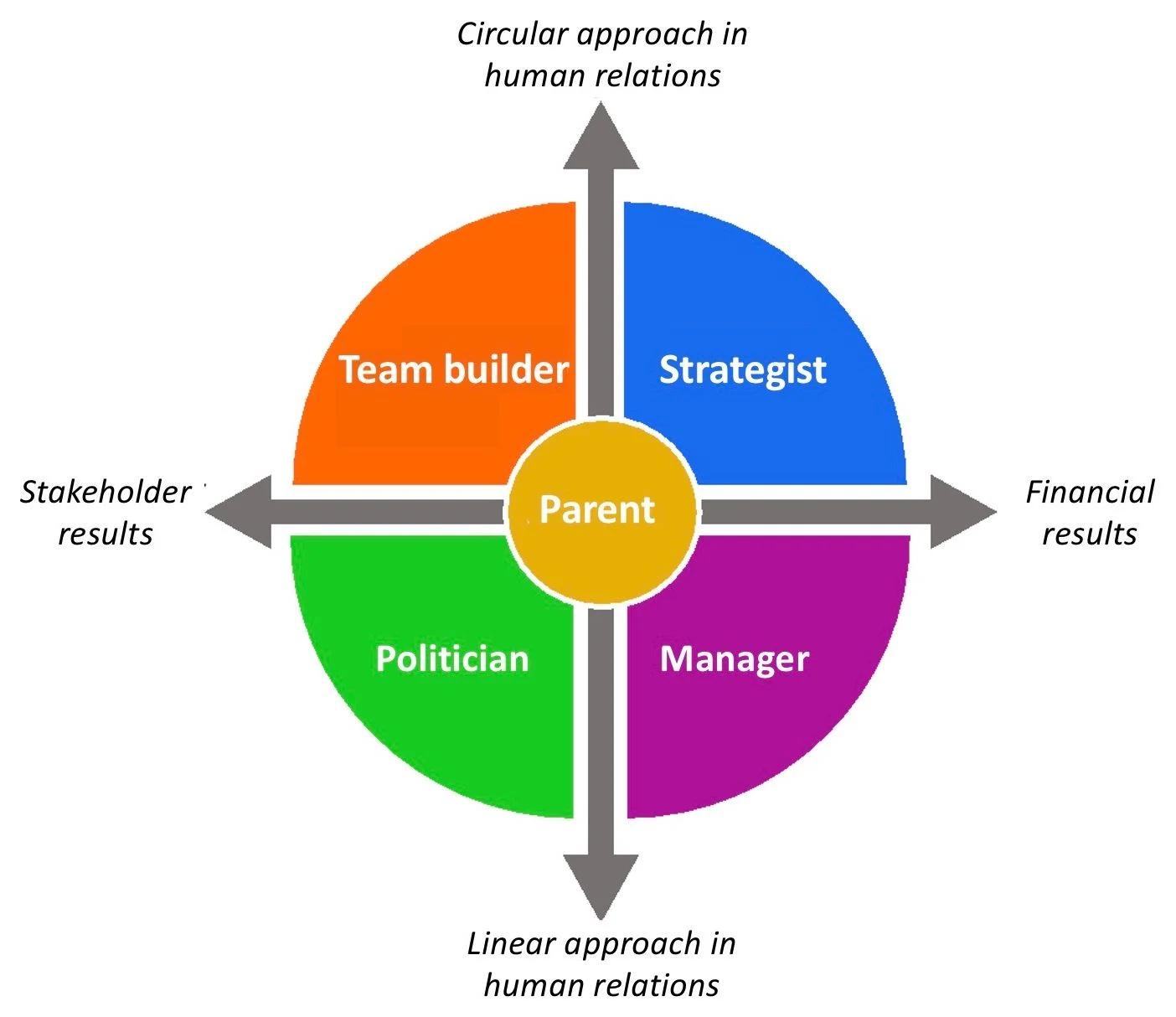
As you can see below in the Complete Leader Compass, there are five leadership domains you need to function in as a leader. This means you need to be able to look at your everyday leadership from five lookout points, and if one of the lookout towers has collapsed, you as a leader will overlook 20% of your success criteria.
As the axes in the compass below show, the leader’s overview and success depend on being able to switch between a focus on financial results and a focus on stakeholder results. In addition, the middle manager must be able to switch between a linear and a circular approach to human relationships.
The Manager
The typical Manager is a person who, in relationships with other people, expresses:
- Dominance
- Responsibility
- Organisation
What is a result for the Manager? For the Manager it is about financial results, which in practice means “that we are making money now, because we have more income than expenses measured over a short time span such as a day or a week”.
How does the Manager think about relationships with other people? The Manager has a linear approach to human relationships: I must reach my goals by getting other people to execute quickly and efficiently. My strategy for achieving quick and efficient execution is clear and explicit communication of my demands and expectations, along with follow-up and motivation when things go off track.
The Manager is quick to make decisions, give “orders” and follow up, so that nothing falls between the cracks. Employees respect her for being clear and explicit in her views and communication. In a tense situation the Manager can at times seem intimidating to her employees, and what many others see as “difficult conversations”, the Manager often finds no problem saying. But it may then be said in a way that does more harm than good.
The Manager values honesty, which for the Manager means that you say things as they are – and straight away. If you are the cautious type and wrap your messages up a little, the Manager may see you as dishonest, because she may not pick up at all on what you are saying between the lines. The top leader has to have some Manager in her, otherwise a leadership vacuum and a laissez-faire leadership situation can arise, leading to conflicts, power struggles, low well-being, stress and high sickness absence. In addition, there is often a great need for the Manager in first-line management in very action-oriented companies, because it is important to create results NOW.
You can hear her say “just fix it”, and she can easily make 4–5 decisions while walking through the company’s premises. When this first-line leader is promoted to a higher level of management, there is a strong need for the leader to supplement her well-developed “Manager” relationship and results competences with the others.
Exercise 1
- Which goals is it important for you to have for YOUR leadership results within the Manager’s domain?
- How important is each goal for your success as a leader on a scale from 1 to 10?
The Team Builder
The typical Team Builder is a person who, in relationships with other people, expresses:
- Empathy
- Social interest
- Communication
- A feel for the situation
What is a result for the Team Builder? For the Team Builder it is about stakeholder results, which in practice means “creating a sense of community, well-being and good relationships”.
How does the Team Builder think about relationships with other people? The Team Builder has a circular approach to human relationships: I must create a sense of community, well-being and good relationships, and I achieve that by being open and giving something of myself, while showing interest in other people’s personalities and needs. I build up an ability to see other people from the inside and to see myself from the outside, so as not to be locked into a linear relationship with other people.
The Team Builder is people-oriented, and for her the way people speak to each other matters. This is a person who is genuinely interested in and attentive to other people, and that is central, because it means she masters presence and recognition, which matter a great deal for employees’ intrinsic motivation. The Team Builder is also competent when it comes to working with her fellow leaders, because she is good at thinking in terms of the whole, and at seeing that it is not just her who has to win.
For the Team Builder, “we do it together” carries a very high value. If the Team Builder is in a management team made up entirely of Manager types, she can add a great deal of value to the team’s functioning and health. But if the top manager is the laissez-faire type, the Team Builder can be outmanoeuvred by all the Manager types, who in that case may see her as weak and perhaps not understand the value she can create. The Team Builder may find it very draining to assert herself and set boundaries. You can hear her say “you’re worn out, go home now and come back well rested tomorrow”, or “we really discussed some good topics at the meeting”. The typical Manager should develop her competences as a Team Builder, and especially if the Manager is promoted from first-line management to a higher level, being able to collaborate becomes really important. If you are a top leader – or, for that matter, a leader at a lower level – you can benefit from allying yourself with a Team Builder in the group who can help you find your way through the human landscape.
If you are a Team Builder by nature, it can be really important for you to develop within the Manager’s and/or the Parent’s domain, because then you can become very successful as a leader. Otherwise, the job of leading may end up putting you under too much pressure and stress, so that in the end you no longer want to be a leader. When you look out over the company’s landscape of people, motivation, collaboration, community and well-being, you are in the Team Builder’s domain. It goes without saying, then, that the Team Builder’s way of relating to others is valuable for the team’s cohesion and performance.
Exercise 2
- Which goals is it important for you to have for YOUR leadership results within the Team Builder’s domain?
- How important is each goal for your success as a leader on a scale from 1 to 10?
The Politician
The typical Politician is a person who, in relationships with other people, expresses:
- Influence
- Tactics
- Negotiation
What is a result for the Politician? For the Politician it is about stakeholder results, which in practice means “that others support me and give me their backing”.
How does the Politician think about relationships with other people? The Politician has a linear approach to human relationships: I need support and backing from other important people, and I achieve that by selling myself when I communicate with them. I have two strategies for gaining support and backing: 1) I build my credibility as someone who understands business, who can be trusted and who can bring about change, and 2) I build a network of relationships and alliances with important others, where we understand and listen to each other.
The Politician has an eye for what today is often called stakeholder management, and she is skilled at establishing partnerships that go relatively deep. She guards her reputation as someone who is 1) credible, 2) has insight into what drives the organisation and 3) is loyal when it counts. It is about thinking realistically and having an instinct for what brings other people with you or, alternatively, against you, and then using her competences to create organisational effectiveness.
She is equally at home being shrewd under the radar and, when it counts, standing up for herself and her friends with tremendous force. As described earlier, a Manager type who lacks the Team Builder could come unstuck when she is promoted from first-line leader and upwards. If the Politician is the blind spot, things can also go badly wrong, because the Manager can truly become a bull in a china shop. When you communicate with the Politician, her choice of words is not just an impulsive reaction to the situation at hand. She is able – in a flash – to analyse the political significance of the situation, and what she says is well considered. Her well-considered communication does not mean that she falls behind and communicates very slowly. On the contrary, her considerations and communication are often so fast that it is others who risk feeling they need a breather.
Exercise 3
- Which goals is it important for you to have for YOUR leadership results within the Politician’s domain?
- How important is each goal for your success as a leader on a scale from 1 to 10?
The Strategist
The typical Strategist is a person who, in relationships with other people, expresses:
- Reflection
- Long-term thinking
- Creativity
What is a result for the Strategist? For the Strategist it is about financial results, which in practice means “that there is a realistic strategy for how we will make money in the future, so that I know we are steering the future and not the other way round.”
How does the Strategist think about relationships with other people? The Strategist has a circular approach to human relationships: I need a realistic strategy for how we will make money in the future, so that I know we are steering the future and not the other way round. I achieve that by involving relevant others in a) the analysis of our current situation, b) the development of solutions and c) a plan with defined projects and committed project owners. The Strategist has to break free from linear thinking and is able to observe through other people’s eyes – not only through her colleagues’ eyes, but also through the eyes of customers and competitors. It is about openness and involvement.
The Strategist sees the company from a helicopter perspective, and she sees it in the context of its surroundings and its internal resources. The Strategist is cool, with a sharp overview, and has abilities that can be used both in certain specialist roles and as a top leader.
The Strategist’s competences are not always fully appreciated in middle management jobs, where there is more focus on operations, short-term results and people management. The Strategist is skilled at analysis, partly because she manages not to be distracted by everyday small problems and instead focuses her attention on her inner reflections. That is also why she can end up becoming a little distant and inattentive to people who need support and to smaller operational challenges. On the other hand, it is often an advantage if the top leader develops a Strategist gene, because it can ensure that the company does not zigzag but is steered towards a goal on the basis of sound analysis.
You often hear the Strategist say “show me your analysis” and “have you made a timeline?”. Do you remember the four quadrants of the Eisenhower matrix, divided according to whether a task is Important/Not important and Urgent/Not urgent? One of the points of the Eisenhower matrix is that many people spend too little time on the tasks that are Important and Not urgent, even though these are the tasks that let you take control of your job and your life. Tasks that are “Important and Not urgent” lie in the Strategist’s domain, and the Strategist prioritises these tasks and is usually also good at handling them, which leads to leadership that has things under control. The Strategist follows a strategy that makes sense and shows due diligence, instead of being a headless chicken that just races around until it drops.
Exercise 4
- Which goals is it important for you to have for YOUR leadership results within the Strategist’s domain?
- How important is each goal for your success as a leader on a scale from 1 to 10?
The Parent
The typical Parent is a person who, in relationships with other people, expresses:
- Integrity
- Tolerance
What is a result for the Parent? The Parent’s result is to create the sense of security that is the precondition for all other results.
How does the Parent think about relationships with other people? The Parent respects and embraces other people, while also respecting and embracing the situation the company is in. The Parent is genuine, sincere and guided by a connection with her own inner core as well as a connection with other people’s inner core and with the situation seen from above, from a meta-perspective.
The Parent is calm, grounded in her values and has the strength to embrace both people with a different set of values and other people’s frustrations. The Parent is often also good at handling pressured situations and complex challenges without losing her footing. Sometimes people say of someone that they are filled up to the neck with worries, so you shouldn’t go to them with new problems, because then they will explode. With the Parent it is the other way round: the Parent is so resourceful that she almost always has a free mental space that can hold a new problem, without the Parent’s limits being reached or crossed.
She is good to have on the team, because she can stabilise situations that would otherwise lead to conflicts and bickering. These situations are often marked by uncertainty that creates conflict in a team, because everyone is infected by the uncertainty and takes up defensive positions that can make grown adults behave like children, with jealousy, envy, anger, scapegoating, victim roles and bullying.
The Parent creates security and calm around her, because her inner balance and confidence rub off on other people, and because her tolerance makes others feel recognised and accepted. The Parent’s communication is always on an equal footing with mutual respect, and she is the type who can talk to all kinds of people. She is brave, with good self-esteem and in good contact with her own “inner voice”, and if she occasionally has doubts, it doesn’t make her insecure – she can hold the doubt too.
Exercise 5
- Which goals is it important for you to have for YOUR leadership results within the Parent’s domain?
- How important is each goal for your success as a leader on a scale from 1 to 10?
Different domains in focus at different career stages
Which domain is in focus differs depending on where you are in your leadership career. The table below is based on just over 2,000 Danish leaders and says something about 1) which leadership results and 2) which ways of relating to other people are in focus at different career stages.
| Top leader | Experienced manager | New leader | |
|---|---|---|---|
| 1st priority | Parent | Politician | Team Builder |
| 2nd priority | Strategist | Parent | Politician |
| 3rd priority | Politician | Manager | Manager |
| 4th priority | Manager | Strategist | Parent |
| 5th priority | Team Builder | Team Builder | Strategist |
Professor Erik Johnsen, dr.oecon., was my supervisor and mentor
Erik Johnsen was my supervisor and mentor in developing the Complete Leader Compass. I carried out 25 qualitative personal interviews with top leaders such as Kurt Larsen of DSV and Anders Eldrup of Ørsted/DONG. I chose to interview top leaders because they know both the top and the middle manager’s position from their own experience, and today they monitor the middle managers. That makes them good informants with a holistic view.
Your final reflection exercises
- Go through the five leadership domains and identify the three most important leadership results you need to create.
- For each of the three important leadership results you have identified, describe how well you are doing at reaching your goal on a scale from 1 to 10.
- When you reflect on how you relate to other people today, is it fully appropriate for creating the leadership results you need?
- What are you really good at when it comes to human relationships (your racehorses), and could you use it more than you do today?
- If you find that you may even have a pig, try to reflect on how you would like it to be. Try to picture your ideal scenario in your mind’s eye and imagine the leadership results it would bring if you could relate to other people in the way you have now set as your goal.
- Try writing down your reflections on what you want in detail, put them away and take them out again at intervals – then you are on your way towards development.
- Also try taking your reflections to someone you use as a sparring partner and who knows you well as a leader. Ask them for feedback and a good dialogue – then you are even further on your way towards development.