Contents
Foreword by Leif Pjetursson
Many leaders are action- and solution-oriented people who by nature are reluctant to turn their gaze too far inwards. However, my experience with hundreds of leaders, whom I have coached or taught on leadership programmes over a number of years, is that it is very eye-opening and enriching when they learn to observe and become aware of their patterns of behaviour, their values, and the thoughts and feelings they subscribe to, which are shaped by culture and organisation.
That is exactly Anders Amstrup’s purpose with this article, in which he focuses in particular on how we can become wiser about ourselves as people and leaders with the help of psychologist and Harvard professor Robert Kegan’s (b. 1947) model of human maturity. In the second half of the article he sets this model alongside core concepts and models known from systemic-constructionist theory.
Kegan’s model draws on a long history within psychology and philosophy. You can see many similarities with developmental psychology and life-span psychology, with well-known representatives such as Sigmund Freud and Erik H. Erikson. Philosophically, there are similarities with Søren Kierkegaard, who stresses that as a human being you must learn to choose and accept yourself as the person you are, and at the same time arrive at a fundamental view of life that you are willing to live and die for. There are also similarities with the American psychologist and management guru Stephen Covey’s famous book The 7 Habits of Highly Effective People, in which he points out, among other things, that as a person you should write down a personal mission in life.
Kegan’s achievement is that he places life-span psychology within a systemic-constructionist framework that fits the constant changeability of late-modern society, both personally and organisationally. Here, for example, the ability to navigate, lead and continually create your own identity are very important competences, which he underlines with the fifth, “highest” stage of maturity, the postmodern self. Here he also underlines the ability, as a human being, to shift between many perspectives and “see” many truths. It is, on the other hand, thought-provoking that you do not find a real ethical dimension in his model of maturity. In that way a relativism of values lurks in Kegan’s model – that “everything is equally good” – which is something systemic theory has often been criticised for as well. By contrast, in Søren Kierkegaard, for example, you find ethical and value-based factors in the form of the two highest stages of his model of development – the ethical and the highest: the religious stage.
Kegan’s model consists of five stages, which Anders Amstrup describes thoroughly and well in his article, in terms of how the individual stages show themselves at different ages and in different situations, and here he also draws honestly and openly on many personal experiences and examples.
For each of the stages he draws parallels between the characteristics of that stage and being a leader. Through this, many will be able to recognise themselves, for better and for worse, as people and as leaders, which can be both thought-provoking and an eye-opener. It is exactly here that learning can take place, when you as a person and a leader hold up the individual stage as a mirror. In what ways can you recognise yourself as a person and a leader in each stage of maturity? What works well? What could you usefully work on, experimenting with changing what you experience as unhelpful, with a view to finding something more valuable?
Anders Amstrup then puts Kegan’s model of maturity into perspective and compares it with the systems pioneer Bateson’s four levels of reflection, with the systemic core concept of self-creation (autopoiesis), which can characterise both people and organisations, and with Pearce and Cronen’s overarching systemic-constructionist model of communication, which describes the forces that come into play and affect all kinds of communication situations (the context, culture, the individual’s preconceptions, the relationship between the parties etc.). By adjusting and changing these forces, you can work on changing unhelpful communication into communication that is more desirable for all parties.
I would particularly like to highlight the ability to reflect, which also runs like a common thread through Anders’ article and the various theoretical key concepts and perspectives he goes through. Since the beginning in 2003, the ability to reflect consciously has been a central concept in the many systemic-constructionist leadership programmes in Denmark, from diploma to master’s level. In that connection we talk about developing leaders into reflective practitioners, who are able to reflect on and see themselves and others from the outside, who are able to listen to and see the world from different perspectives, but who are also able to bring about preferred, desirable worlds. There is great value for insight and innovation in exactly this movement, because it forces us continually to think the world anew, to renew ourselves as people and as organisations, with respect for where we come from, where we want to go and what is valuable. In that sense, too, there is inspiration to be found in Anders Amstrup’s article.
Leif Pjetursson, May 2019
Introduction
In this article you are introduced to Robert Kegan’s developmental-psychology approach to leadership. Kegan fascinates us leaders with optimism and meaning, because we realise that we are not stuck; on the contrary, we are on a journey of development in which we lift ourselves throughout our lives.
At each stage of development we meet leadership challenges, and as we mature, through reflecting and tackling challenges and crises, we move on to the next stage.
Robert Kegan is a constructivist, which means that he does not see people as passive recipients but as active, meaning-making individuals who construct their own understanding of reality. As a developmental psychologist, Robert Kegan’s contribution is that he sees that your way of making meaning of reality changes and matures throughout your life. The higher the stage you are at, the more complexity in your life you can constructively make meaning of without becoming defensive, stressed or the like. The different stages represent levels of social maturity, because it is your awareness of the relationship between you and the community that is lifted and matured. In other words, you get better and better at reading and understanding the complexity of your relationships with the community.
The demands on leaders have become different and greater as a consequence of globalisation and the shift from an industrial to an information society. Kegan identifies the new demands on leaders very precisely, and he shows what new personal competences are needed in postmodern society. It is therefore “spot-on” when many leaders want to develop their own personal leadership competences through leadership programmes and coaching. Globalisation has made society more complex, and so there is a need for leaders who are able to navigate and act in complexity.
I think Kegan becomes even more useful when he is set against interesting theorists from the world of systemic psychology. That is why I round off the article with a leadership-based perspective on Kegan, inspired by Bateson, Pearce-Cronen and Maturana-Varela.
If this article has made you want to read more about Robert Kegan, my best suggestion is Jennifer Berger’s book “Changing on the Job, second edition”. It is important that it is the “second edition”, because they are very different books. If you want to read Robert Kegan’s own texts, I can suggest his two main works “The Evolving Self” and “In Over Our Heads”. But be warned: according to Robert Kegan, his own father could not face reading Kegan’s books, because – according to his father – they were written in a somewhat incomprehensible way. In addition, he has written four books with Lisa Lahey, which are also interesting but do not focus on Kegan’s own model.
This article was originally published in 2019 in Lederne’s news magazine. In the summer of 2026 minor adjustments were made. Mainly, Kegan’s shift from talking about “selves” to talking about “minds” has been implemented.
1 Robert Kegan’s model of human maturity
Psychologist and Harvard professor Robert Kegan developed “The six stages of social maturity”, which describe the personal development of ordinary people. Kegan’s model is based on the idea that we as human beings make our own meaning of reality. As we grow up and get older, we make meaning of reality in new ways. According to Kegan there are specific stages of development that describe how we as human beings make meaning in different ways at different points in our lives.
You can compare it with rereading a novel at 30 that you first read when you were 15: now you read the book in a new way and get something different out of it, because you have moved to a different and higher stage. In the same way, you will again get something new out of the same book when you are 55, compared with when you were 30. That is because you mature into new stages, where you observe the world with new eyes, and as a result you make new meaning.
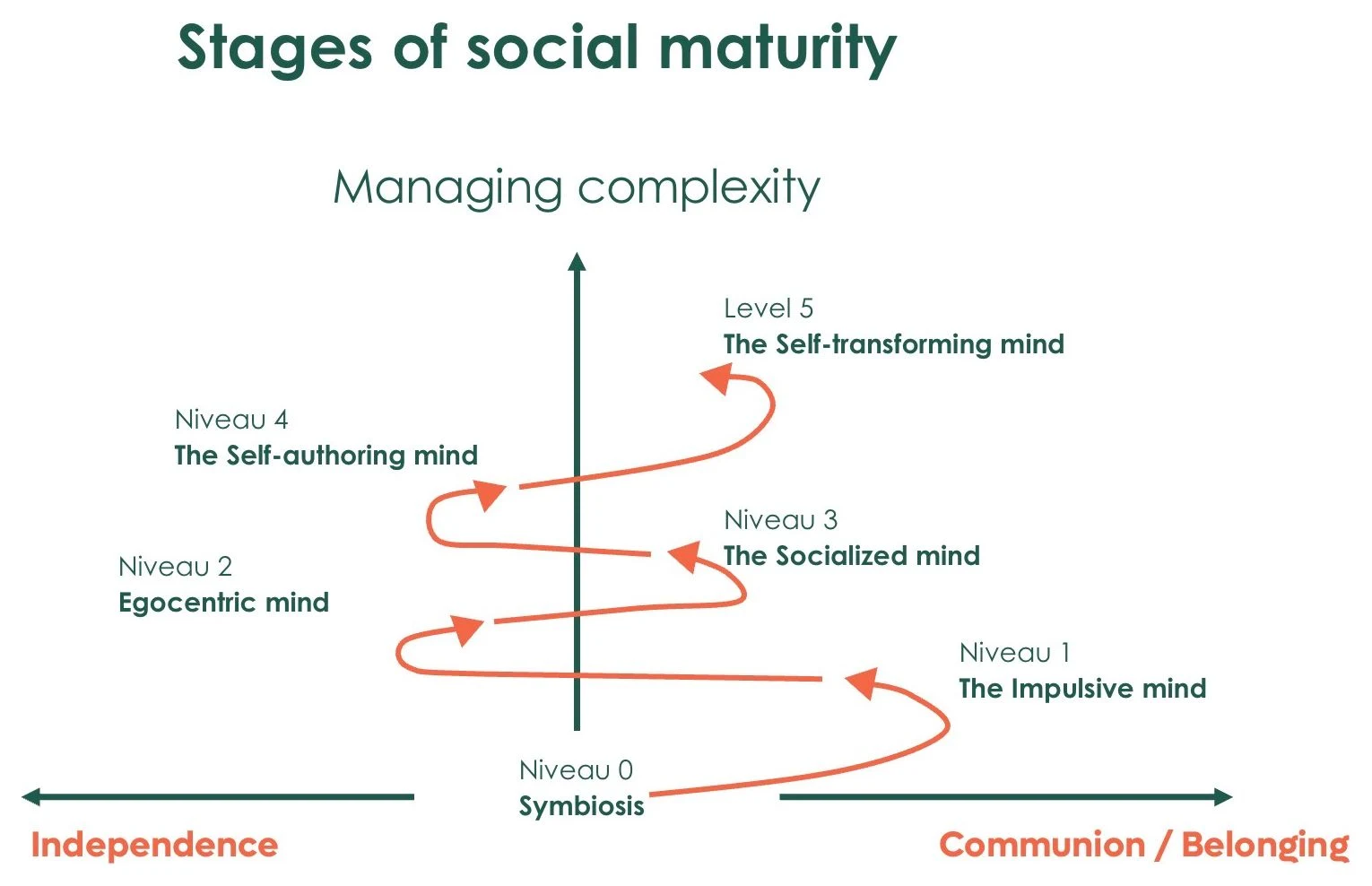
Kegan’s model describes how, as a human being, you develop throughout your life and move through six stages, from stage 0 to stage 5. According to Kegan, you swing through this journey of life like a pendulum between two poles: the right pole, where you focus on other people, on the community and on the needs of others, and the left pole, where you focus on yourself and your independence.
Stage 0: Symbiosis
The first step in Robert Kegan’s model is called Stage 0, or Symbiosis. The newborn baby does not have much experience of community or of life as such, since the baby has been in symbiosis with its mother for nine months. When the baby has just been born, it mixes itself up with its surroundings – it is unable to distinguish between what is “me” and what is my surroundings. At this point in life the baby, so to speak, is not in control of anything in itself or in others. Instead, the baby is controlled by its reflexes and by what it immediately senses. The kinds of reflexes that control the baby are, for example, grasping, rooting, sucking, crawling, blinking. The baby is not aware of wanting to grasp, root, suck or crawl; it is the reflexes that control the baby. The reflexes, in turn, are triggered by very basic sensations – for example, the baby feels something in its hand and tries to grasp it and hold on, feels the mother’s nipple on its cheek and starts searching for food, gets something in its mouth and starts sucking to get food. All of this happens automatically, without the baby being aware that “I exist, and there you are”. It goes without saying that the capacity to handle complexity is low at level 0.
Stage 1: The impulsive mind
The next stage in Kegan’s model is called stage 1, or the impulsive mind, and begins around the child’s eighteenth month. According to Kegan, you gradually become able to distinguish between yourself and others, “me, and what is around me”, and able to control your reflexes yourself. On the other hand, you are now controlled by your impulses and feelings. Instead of merely sensing something that then triggers a reflex, Kegan says, the child is now able to hold an image of what is out there in its mind. But at this stage the child can still only hold one image at a time in its mind. This means that the child’s perspective cannot become very nuanced. This is where the expression “out of sight, out of mind” makes sense: when the child no longer sees the thing it is looking at, the thing no longer exists. The child is also only able to have one feeling at a time, and so the child’s behaviour also becomes impulsive. The feeling the child has about the one image in its mind takes up everything. What the child wants, it wants NOW, because there is nothing else in the child’s mind.
Kegan says that at this stage the child can recognise its parents. Not as people in their own right, however, but as people who are important because they can give the child food and safety, etc. A parent may therefore feel recognised by their child at this point. But the child does not recognise its parent on the parent’s own terms, as a person with their own values and needs etc.; the child recognises its parent as a source of food and safety.
At this stage something is also established that can be compared to the beginning of occasional low self-esteem. The child discovers that it is completely dependent on others and cannot do anything by itself. When the child tries to do something by itself, it cannot, for example, get up out of the little chair it is sitting in, or it falls over if it tries to walk. The child’s experience of not being able to do anything by itself – “The big people out there can do everything, I am completely dependent on them” – can sow the seed of occasional low self-esteem. It comes knocking when, as adults, we now and then find negative thoughts about ourselves suddenly popping up in our minds (perhaps triggered by an event, or perhaps just because we are all alone and the television isn’t on): “You’re so useless. What you did today – you just made a fool of yourself in front of everyone, you’re worthless, people are laughing at you and think badly of you”. The seed of these thoughts, the feeling of low self-esteem, is sown here, then, in early childhood. This feeling is not at all unusual; it is a universal human feeling that everyone can have from time to time. It is nothing you need to be afraid of with regard to your own children, and nor should you think you are special if you sometimes think “I can’t – I’m no good – others must be disappointed”. Then you are just completely normal.
Fortunately, the child gradually becomes able to do things by itself: for example, tying its shoelaces, writing letters in a book at school, walking its sister to school, etc. At the same time the child discovers that it can take the initiative itself, that it can be an “agent” who sets things in motion – for example, kicking a football so the ball goes into the goal. The child thereby discovers that “I am actually an agent of action here in the world – I’m OK”. With that, the child moves towards the next stage in the model.
Stage 2: The egocentric mind
Stage 2 is called the egocentric mind and begins at the age of five to seven. You know that your child has reached stage 2 when it comes home from school and says: “Mum, why do we have to do maths? You can’t use it for anything at all”. Or: “Dad, why do I have to be home at 10.30 in the evening? Do you realise you are ruining the best years of my life (I am 10)”. At stage 2, according to Kegan, you are no longer controlled by your impulses – you now control your impulses yourself. On the other hand, you are controlled by your needs. This means that at this point the child is perfectly able to look out at the social world and at the people out there. But the child looks at the people out there in the social world through a thick, sticky filter of its own needs and wishes. For example, a child of 10 or 8 can certainly have a guilty conscience. But the child does not really feel guilty because it has done something that goes against its own values, or because it is able to put itself in the place of another person it has hurt. The child at stage 2 feels guilty, rather, because it is afraid of being found out and afraid of what the punishment will be. So it is, as it were, for selfish reasons that the child gets a guilty conscience.
At this stage you are generally self-confident and have a good overview of your world – simply because the world is not very complicated at this point. The child can, for example, say to another person: “Look, here is my room, here is my LEGO, here is my racing track, and here I have a secret room that you are allowed to see”. The child can also say: “Look, here is my school, here is the way to school, this is where we play football, and here is a shortcut we can cycle along”. This, then, is the child’s world, which we now have an overview of – and because there is not terribly much in the child’s world that it needs to get an overview of, the child also feels quite sure of itself. Now and then you may wonder how a child of this age can seem so self-confident, almost cocksure, but it is not surprising, given that at this point there is not that much for the child to keep track of. Robert Kegan has a kind of nickname for this stage, which he sometimes calls “the little emperor”.
Stage 3: The socialised mind
Through adolescence, as the wider world slowly reveals itself to the child, the world suddenly starts to become more complicated. At this point the child develops from stage 2 to stage 3, the socialised mind. At this stage, according to Kegan, it is the social field, with groups and other people, that controls you. On the other hand, you now control your needs yourself, which previously controlled you. When you reach stage 3, you are an adult: you can now have a mature relationship with other people, where you have the other person inside you, so to speak: you can feel what the other person feels, and you can think what the other person thinks. You also no longer see other people solely as means to achieve your goals. At the same time you experience that your self becomes more conversational, more of a dialogue: you get a kind of inner voices that talk to each other inside you. These inner voices have a psychological function, namely that through these inner conversations with yourself you are able to exercise self-control and adapt to the group.
At this stage you discover how complicated the world is: “The world is big, and what are you actually meant to do in this world, what does the world want with you, how do you find a role in society that you are happy with?”. You also discover that you are very dependent on relationships with other people. At this stage it is not just about being right, but about being proved right – and those can be two completely different things. You naturally become more humble than you were when you were the Little Emperor, because you discover how small you are in the big world. It starts to matter to you what other people think of you, and whether they like you. You become the type who proudly writes “Well liked” on your CV.
In addition, you sometimes become – to use a slightly negative word – conflict-averse. Somewhere inside you are constantly on guard against, and afraid that, others or you yourself will lose face and self-esteem in relation to the group. Your conflict avoidance therefore comes to take up a lot of space in you: for example, you tend towards “mumble communication” when a conflict arises, where you don’t quite manage to say what you mean, but mumble it between the lines. Afterwards you may perhaps convince yourself that you did say what you thought in the situation – but none of the others present could really hear it. The reason is not really that you lack courage or strength. Instead, imagine that your mind is a physical room in which 95% of your mind is allocated to registering – with some big antennae and radars – what other people think, feel and believe, what views others hold, what others think of you, and whether others like you. On the other hand, only the remaining 5% of your mind is set aside for what you think, what you feel and what your views are. This creates an imbalance in your perception of the world: you become far too good at registering other people’s thoughts, feelings and views, and not good enough at being in touch with your own views, thoughts and opinions. Imagine that you are crawling across the Sahara desert. The sun is beating down on you, and you are dying of thirst. Suddenly you are lucky enough that a helicopter happens to land next to you. Out of the helicopter step a number of tourists who have come to look at the desert while drinking cola through straws. One of the tourists says to you: “You know what, have a sip of my cola”, and hands it to you. Your natural reaction at this stage of the model would be: “Are you sure you have enough?” Or: “Do have a sip yourself first...”. That this is your natural reaction simply shows that you have an imbalance in your perception of the world. An imbalance that makes your behaviour conflict-averse, even though you lack neither courage nor strength.
It is not relevant to see the conflict-averse behaviour at stage 3 as a possible sign of low self-esteem. On the contrary, it is about the particular way you make meaning at this stage – by seeing everything through other people’s eyes and other people’s feelings, including yourself. When you try to make sense of yourself, you do it in the same way, by looking at yourself through other people’s eyes and with other people’s feelings. Which does not leave very much room for you. So your self-esteem is fine; you are just not very good at looking at your surroundings factually and from your own perspective. Your perception is contaminated by the social field. When, in your development, you came from the egocentric mind (stage 2) to the socialised mind (stage 3), it was a good thing that the social field took you over, if I may put it that way. It was necessary for you to become a person with the ability to cooperate and with good relationships with others. Not everyone develops further, and they remain at stage 3.
With all this in mind, can you say that it is great being a leader at this stage of Kegan’s model? No, not always, because you will often experience cross-pressure between your employees and your own manager. A cross-pressure that also feels intense, because as a leader you are not able to make demands, set boundaries and communicate clearly about your needs to your employees and your own manager. At the same time you will experience cross-pressure from the leaders on the same level as you; it will seem as if the other leaders are eating into your territory without you saying stop and putting your foot down. You are thus exposed to cross-pressure from below, from above and from the side, and may therefore experience your working life as a leader as very stressful. To handle these cross-pressures constructively, it is of course important that you as a leader move on in your process of development and personal maturity. Fortunately, being appointed as a leader while you are at this stage will typically set in motion a personal process of development towards the next stage in the model.
An important addition is that as a leader at stage 3 you simply spend too much of your time and attention on not wanting to hurt others. When you finally express your own needs, it typically comes out sounding shrill and perhaps even aggressive. According to the model, this is because at this stage it will be very difficult for you to hold two sides of the same feeling at the same time. In a given conflict with another person, you can easily feel the other person’s needs, understand why it is important to show the person consideration, and sense that you need to tread carefully in the situation. But you are not able at the same time to hold your own needs and what you actually want. You switch between one side and the other, so that when you finally think: “No, now I really have to express my own need”, you do a complete U-turn. From thinking only of the other person’s wishes and needs, you suddenly go to thinking only of yourself and your own needs. This means that when you express yourself and your own needs, it comes out sounding shrill and aggressive, almost like a bad version of the Little Emperor from stage 2. Which is not really in your nature at all. Another everyday example is a person at stage 3 who wants to complain about a faulty product and therefore goes back to the shop where it was bought. The person can become so nervous about having to talk to the shop assistant about the complaint, which of course involves a conflict, that the person is suddenly only able to see the matter from their own point of view. The person simply cannot hold two sides of a feeling in their mind at the same time. The person therefore ends up sounding furious with the poor shop assistant, because the person is afraid of not being taken seriously.
This discomfort with handling conflicts by talking calmly and like an adult with the other person can also lead to “trench warfare”. Instead of talking calmly with the other party about our disagreement, the stage 3 person may choose to gather a few people around them, the safe and good people. We stick together and agree with each other that the other party in the conflict is the bad one. In this way the stage 3 person feels they get to express their views and their disagreement with the other party; it is just not the right people they are talking to. At stage 3 you can even get to a point in a conflict where you end up sounding very “macho”, because you might say, for example, “sometimes you just have to say cut-the-crap; I don’t want anything to do with him from now on”. It is still an escape from the other party, and typically there has still not been an adult, calm conversation between the two. It may sound “macho” to say “cut the crap”, but it is still an escape; it is a defence mechanism. More precisely, it is the defence mechanism called splitting, where whatever makes the person insecure is split off, and now it no longer exists; like the child who covers its eyes, and now you are gone as if by magic. It is not unusual for an otherwise easy-going and sociable person at stage 3 to react under pressure with defence mechanisms like these. Defence mechanisms that are otherwise normally associated with people who suffer from “borderline” personality disorder. You could almost say that the pressured level 3 person, in a perceived conflict, is hit by a temporary personality disorder, with all the “noise” in social relationships that this brings with it.
All in all, it is important as a human being, and not least as a leader, to move on from stage 3 towards stage 4, since stage 3 is not a constructive or helpful stage for a leader to be at.
The way to stage 4 is to get to know yourself, warts and all: “What are my strengths, what are my weaknesses?”. That you accept yourself as the person you are is extremely important – and also harder than you might think. Here I will use an example from my own life. When I was a young leader myself, around 28, I believed (as other younger leaders sometimes do) that I was “God’s gift to Danish business”, a really good leader. My very first employee, Marie, once tried to hint to me that there was something called leadership courses. I can still remember that my reaction was to talk louder and louder and louder until she understood that this was not something we were going to talk about any more. The reason I still remember the experience so many years later is, of course, that the experience was anxiety-provoking at the time. The person was indirectly confronting me with my real image, while I had an idealised image of myself that I believed was my real image. At that point I was not ready to accept myself as the person I really was. The problem, though, is that when you will not accept yourself as the person you really are, including faults and shortcomings, something inside you clings on desperately, so that you do not develop but stay where you are. That is why you have to accept yourself as the person you are, including whatever faults and shortcomings you may have. Once you have reached the point where you dare and have the courage to accept yourself as the person you are, on the other hand, something inside you lets go. The way is now open to develop and slowly become the person you would like to be – the potential can come into play. It is therefore very important for your personal development and maturity that you are able to accept yourself as the person you are. But it is also really hard.
The way to stage 4 is also to learn to be fond of yourself (in the past the expression “love yourself” was used, but we have lowered the bar a little, partly because some people find the expression hard to use). It can, however, also be hard for some people to say that they are fond of themselves. But as a leader you need to be able to be fond of yourself, which also includes doing some good things for yourself now and then. This could be an exercise for you: think about what you do when you want to be good to yourself. Finally, the way to stage 4 is to get to know your own values. When you know and are aware of your own values, they become more a part of you and a part of your self. Your values become something you can lean on in life’s storms, and when you find yourself in a dilemma. Your values give you security.
If you are at stage 3 when you become a leader, the key is to get started on developing further towards stage 4. The development will often start by itself, because as a stage 3 leader you are confronted with quite enough unpleasantness. You will very often struggle with conflict avoidance, be locked in cross-pressure between different people’s expectations of you, feel you are not up to the job because you do not communicate in good time and clearly, you cannot say “no”, you may have to live with your employees indirectly letting you know that you are vague and lack impact, and self-appointed leaders pop up among your employees who want your position, because they experience you surrounding yourself with a leadership vacuum. That is why it is not pleasant being a stage 3 leader.
I have spent extra space describing the stage 3 leader, and that is because a great many leaders are on life’s long journey from stage 3 up towards stage 4, the self-authoring mind. In addition to what I have already described about what you can do to move on, I would like to add four things I have discovered. Firstly, I believe you need to get better at listening to yourself. It is of course worth its weight in gold to be able to discuss things with others and gain new inspiration and confidence that way. The problem is that when you are at stage 3, your urge to brainstorm with others is far too strong; try also to refrain from involving others in an issue, and then try to carry it entirely by yourself until your own answer starts to take shape inside you. When you are at stage 3, you really do not feel like carrying the issue around inside you. If you are in conflict with another person, you are welcome to discuss the matter with that person, but it is all your “advisers” you should try to do without. It is so tempting to discuss the matter with others, and then the others end by saying “now feel deep inside yourself, and then make the choice that feels most right”. The problem is that what you feel inside yourself in that situation is not you; it is the social field you are feeling, and the relief. The relief of not having to make the choice yourself. So you chose the easy solution and passed on the responsibility, because it was unbearable. So the exercise is: start working with some issues that you can bear to hold inside yourself until you have made up your mind, even if you feel lonely and at a loss. Many people say they would like to find themselves, but it is hard to find yourself if every decision has to be discussed with others. Try making some decisions on your own if you would like to find yourself. Existential choices in particular, where you sense a risk to your relationships with other people, are well suited. You will experience loneliness, uncertainty and not least anxiety about the consequences, but if you cannot live with that, it will be hard for you to find yourself, and you end up staying at stage 3. You also lose some of your authenticity, because people cannot trust you and do not know which version of yourself you are today if you always have to talk your own decisions into place with others. A kind of core is missing – you are missing.
My second piece of advice is that you should not be afraid of other people you are on your way to confront about a conflict between you. Imagine that you feel someone else has done something wrong to you, and now you are going over to the person to tell him so, and that he must stop. At first you thought it was a good idea, but on the way over to the other person you become more and more unsure, your legs go a bit wobbly, and you can feel the other person’s angry reaction. My point is that it is not the other person’s anger you can feel at all. It is your own anger you are feeling, but because you are not used to being angry and expressing your anger, you cannot recognise it. You are not used to confronting another party with your anger, and so your own anger can make you unsure when you feel it inside. My point is that you should not be afraid of the other person when you are on your way to a confrontation; no, if anything it is the other person who should be afraid of you. I say this with love, because of course the point is not for us to frighten each other. My point is that you are much stronger than you think, so you really just need to dare to take the chance, and be open and honest when you talk to others, and then you are on your way to stage 4.
Thirdly, you can ask yourself whether right now you are acting to reach an attractive goal or to avoid discomfort. It is actions towards a goal that are constructive for you and that give you the power to act. Actions away from discomfort are an escape from the situation, so that you distance yourself and step out of the relationship in which the problem was to be solved – such as a difficult conversation. So do not let the feeling of discomfort steer the actions in your leadership; either you lock yourself even further into cross-pressure, or you perhaps “miss” a big opportunity. The fourth thing you can pay attention to is the concept of “negative capability”, which you can use precisely when you feel the discomfort pushing you to act defensively. Negative capability means that you refrain from acting and refrain from making a hasty decision. You allow yourself to wait. But it requires that you can hold the uncertainty and the doubt during the waiting period. During the waiting period you wait for the situation to work in you, if I may put it that way, and after a while your own answer starts to emerge.
If you hold coaching conversations with a person at stage 3, it is wise to ask lots of questions along the lines of “how do you read the situation?”, “what do you think?” and “what do you think needs to be done?”. All questions aimed at strengthening the person and, in time, helping the person move on to stage 4.
Stage 4: The self-authoring mind
Stage 4 is called the self-authoring mind. At this stage you no longer let yourself be steered by the social field and the group. On the contrary, you can now steer the social field and the group. At stage 4 it is your identity that steers you. According to Kegan, you now have a strong set of values that are truly your values. You can now observe other people and feel with them, but you can do so from the outside, so you are not swallowed up and paralysed by a fear of conflict. You can now hold both sides of a feeling at the same time, so that you no longer, as at the previous stage, have to switch between seeing the situation entirely from the other side and seeing it entirely from your own – which left you either paralysed or acting in a shrill, selfish, aggressive way. You could say that you now own yourself, instead of different parts of you being owned by the different contexts you are part of. You are no longer a chameleon; you become you. You have brought something with you from your journey through life, a kind of core inside you that stays constant, even when the context changes.
You can be a member of a group without being swallowed up by it or depending on it. You have become better at handling conflict, because you no longer depend on others to keep your self-esteem intact. That is why you are better able to listen to what other people are actually saying when you disagree, without becoming nervous and afraid. You are also much better at saying what you think in response to the other person’s view, rather than, as before, becoming nervous and saying something between the lines, and perhaps ending up aggressive or avoiding the conflict and running away. You are better able to confront others and talk with them about the situation in a grown-up and mature way, even when disagreement and conflict arise between you. You do not need to put yourself or anyone else in the role of victim, where it becomes somebody’s fault. You now have the strength to step outside yourself and look at the situation from the outside. You also have the strength to influence and change the situation. That is why at stage 4 you are described as the author of your own life, the self-authoring mind. If other people disagree with you, you do not immediately see it as a conflict, as you might have been inclined to at stage 3. When others disagree with you, you want to discuss the matter with them, and you find it natural to tell them what you think. This is constructive – except when the person you are talking to is at stage 3, because he may become afraid of you and experience it as a conflict when you give your opinion. So it is important that you keep in mind that not everyone else is at stage 4 like you. When you forget this, you can be taken completely by surprise when another person suddenly becomes upset, angry and/or walks away from you. The other person at stage 3 may have seen you as dominating, and may even be very afraid of you, while you for your part have regarded your collaboration as equal and constructive.
At stage 4 it matters more to you to be respected than to be liked. At the same time, being a leader comes naturally to you, because you tend, unconsciously or implicitly, to think of yourself as an institution. You seek to establish yourself as an institution in the social settings you are part of. On the other hand, this can also be your limitation at stage 4 – that you let yourself be steered by your identity and your view of yourself as an institution – because you can become very rigid. What you may need instead is to be more open and accommodating, and to a greater extent be able to see things as more complex. That is exactly what the next stage in the model is about.
Where the stage 3 leader is sensitive to other people and the world around him, the stage 4 leader is typically less sensitive. I once had a boss who said about someone that the person had to be managed the way you train a German shepherd: 50% love and 50% consequence. My boss was rather tired of the 50% consequence, because he felt the only form of communication the person understood was being shouted at. Perhaps my former boss spelled it out a little too bluntly, but there is a point in the fact that stage 4 leaders often do not hear the message if it is said with empathy and between the lines. It often takes a forceful way of putting things before the stage 4 leader hears that something is being said other than what he already thinks. That is also why a stage 3 leader and a stage 4 leader really need to know each other very well if they are to work together constructively. The stage 3 leader may experience the other as selfish, intimidating and pushy, while the stage 4 leader may experience the other as dishonest, closed and driven by emotions and defence mechanisms.
At stage 4 it feels natural to take the seat at the head of the table, and you feel safe and secure, because what others see as a complex dilemma, well, I have the simple answer to that. That gives you security in the job as a leader, and it is typically a security that rubs off, because others feel they can lean on the strong oak tree. You are typically also better at listening than at stage 3, because at stage 3 your listening is so easily contaminated by your defence mechanisms, so you think there is a conflict, that the other person is out to get you, or something similar. At stage 4 you are much better at listening to what others are actually saying, without inventing fantasies in your head. But there is still room for improvement at stage 4. At stage 4 you can easily be so strong in your own inner map that you hear what you want to hear – what fits your way of seeing the world. So you are certainly much better at listening and hearing what the other person says than at level 3, but on the other hand you are so strong in your values and your view of the strategy that you may mostly be listening to work out how to get the other person on board with your plan.
Below I will describe some of the typical challenges you can run into as a stage 4 leader.
- Conflict with other stage 4 leaders. You are both completely sure of your authority and that your view of the world is accurate, so there can be quite a bang when you clash over a disagreement.
- If your boss is a stage 3 leader. If you are yourself a very settled authority who needs people to talk to each other directly and without beating about the bush, you may have a hard time if your manager is a stage 3 leader. Your experience will be that he is not honest with you and that he is manipulative.
- Stage 3 colleagues and employees. As already described, you risk pushing these people away, because they become afraid of you and see you as dominating. They may also choose to compete with you, but they do it in secret, so you only find out when it is too late.
- If others act against your values. Precisely because you are steered by your values, you can react very strongly when someone breaks them. You may lack tolerance for people whose values differ from your own.
- Sloppiness or a lack of responsibility. If you find that someone is not doing a task well enough or is not showing enough responsibility and commitment, you can be downright indignant and very angry.
- Honesty. You are very honest yourself, which shows in your direct and clear communication. You need others to be honest with you too, and always to give you the whole truth. If you feel that others are not being honest with you, you become either angry or insecure, or both at once. Whatever they do not tell you, you construct yourself in your head, and it is usually something unpleasant. The people who are not honest with you are typically stage 3 people, who wrap the message up, talk between the lines or only tell you the positive things, because they shy away from conflict. These people do not see themselves as dishonest, but compared with you, you could well say that they are. They will see themselves as kind people trying to communicate tactfully and considerately, which is why they are not as direct as you.
- Talking down to you. Nobody should talk down to you – that sets you off. You are an authority, after all, you are an institution, and to you talking down to you is almost a kind of “crime against society”. So you cannot accept it.
- Lonely. As a rule you do not think of yourself as lonely, but you risk becoming lonely, because somewhere deep down you are self-sufficient. Opening up to other people, with the vulnerability that comes with it, does not quite fit your picture of yourself as an authority and an institution.
- Heavy-handed feedback. When you now and then need to give someone feedback, it is often delivered too harshly. This is because 1) you think others prefer the same direct form of communication as you, and 2) you think your role is to correct other people’s mistakes, as if you were a walking answer key.
- Others don’t need to like me. Fine that you are independent, but your strength is also your Achilles heel, because you lack the vulnerability that makes you human in the eyes of others.
- Why should others decide over me when I am right? Fair enough, but sometimes you simply have to be a little flexible and not so cantankerously stubborn.
My best advice to you at stage 4 is to dare to trust other people, even if it now and then leads to something that looks like chaos. Secondly, you should take an interest in talking with other people and listen to them sincerely. Where stage 3 leaders need to get better at making decisions themselves, the stage 4 leader is almost too decisive. You will benefit from talking a matter through with others, with the aim of getting better at taking other people’s perspective. In particular, you need to get better at taking the perspective of stage 3 people, so you get better at understanding what is said between the lines.
My last piece of advice is that you should reflect a great deal on the “slaps in the face” you run into, because they will come when you have trodden on stage 3 people’s toes often enough, without realising it yourself. You expect other people to be as honest and straightforward as you are, so it comes as a shock when one or more people suddenly cut off contact with you 100%, without giving you a chance to explain yourself or to improve. If situations like these make you reflect on yourself and on the way you are with others, you may have started the journey towards stage 5, the self-transforming mind.
Stage 5: The self-transforming mind
Most adults are at stage 3, the socialised mind, while a few adults remain at the egocentric stage. Fewer people are at stage 4, the self-authoring mind, although quite a few people are on their way towards this stage. For a great many people, life’s long journey is about being somewhere between stage 3 and stage 4, on the way to finding themselves and the calm and overview that come with it. The stage the fewest people have reached is stage 5, the self-transforming mind. Paradoxically, life in the modern globalised world can look as if we all need to be at stage 5 to function well and be in balance. But only a fraction are at stage 5, so perhaps it is not so strange that many people struggle with mental health problems.
More recently, Kegan, together with Lisa Lahey among others, has described the transition from industrial society to information society in a global world. They make the interesting point that in industrial society the ideal employee was often at stage 3 (the socialised mind) and the ideal leader was often at stage 4 (the self-authoring mind). But increased complexity, the need for self-managing employees and rapid change have meant that today the ideal employee is often at stage 4 (the self-authoring mind), while the ideal leader is often at stage 5 (the self-transforming mind). If this holds true, I think it places greater demands on leaders’ leadership training and personal development, and at the same time it perhaps sheds light on the major problems with work-related stress that we have seen over many years now. Because a great many people have a job that demands more of their social maturity and ability to handle complexity than they currently have.
At stage 5 the model says that you steer your identity. At this point there is nothing that steers you. This means that it is now your mind that steers your organisation, whereas before your mind and the organisation were two sides of the same coin. Your mind was the organisation, your mind was the institution, you were the institution, the institution was you. But at level 5 you are, so to speak, at the top of the order: it is your mind that actually steers the organisation. As a result, where you previously felt compelled to push through and implement particular things – because you were convinced it was important and right, they were your values and the right values – you no longer automatically need to do so. You have moved up to where you can look down on your values, your role and your identity and reflect on them. At the same time you have moved a little out of your own role and the security that lay in the values you had in that role. This makes you less subjective as a person. At the same time, what you see becomes clearer, stronger and more precise – you have gained greater clarity of vision. At level 5 you can to a very high degree listen and take things in without being disturbed either by conflict-avoiding defence mechanisms and fantasies (as at level 3) or by your own strong inner map (as at level 4).
Furthermore, according to Kegan, you have become better at grasping, holding and handling complexity. You are no longer trapped in a role, you are no longer trapped in an identity, you are no longer trapped in a set of values. Instead you are able to switch between many different perspectives. You can once again have the inner conversations with yourself where, for example, you consider conflicts and other people’s needs. But it is no longer a conversation that puts pressure on you or makes you nervous. On the contrary, the conversation brings clarity, helps you get an overview of social relationships and gives you the ability to act. It is an inner conversation with overview, in which you explore possibilities in your relationships with other people in a way that gives you strength and the ability to act – and at the same time an ability to change. In other words, a conversation that gives you both the ability to act and an entrepreneurial drive.
In general, at level 5 you are very good at shifting to other people’s perspective, at meta-reflection, where you are aware of yourself and how you react to the world around you, and even – to a greater extent than others – at managing your emotions rather than letting them manage you.
Some people ask, “can’t I jump straight from stage 3 to stage 5, because stage 4 doesn’t really seem like me?”. Unfortunately you cannot, because you first need to consolidate your strength, integrity and ability to say “no” with natural authority before you have the surplus to be truly open and accommodating, even when you are pushed into a corner.
Robert Kegan’s view of the different stages is not linear, in that you contain the earlier stages within the later ones, and in that under pressure you can be squeezed back to earlier stages. The self-confident boss at stage 4 may suddenly find herself in an overwhelmingly difficult situation, and for a time she is pushed back to stage 3, where she is more insecure and more “what do you think?” than before. Or the friendly, service-minded assistant whom everyone likes and who is always so nice has one day been pushed too far and goes “berserk” at stage 2 as the Little Emperor – now he won’t put up with any more. What can turn out to be constructive, if you find yourself pushed back to an earlier stage for a time, is that it can give you reflection and learning for new development and subsequent growth. The point is that when you develop to a new stage, your “old” stages are still there “underneath” or “inside”.
Another thing that makes the model non-linear is that you may well have “loose ends” or “unfinished business”. You may have generally developed to a high level, but in certain situations, for example if you feel you are being treated with disrespect, you drop straight down into the Little Emperor (level 2). The reason will typically be something unprocessed that you carry around in your backpack, and so you function – in part – at several levels at the same time.
What about the situation-specific – doesn’t how I am depend on the context? At level 3, the socialised mind, you react very strongly to changing contexts, because here you are so much outside-in that the contexts press you into different ways of being. It is different at level 4, the self-authoring mind, because here the context is inside you and not outside. According to Robert Kegan, at level 4 the context is made up of your own strong identity, values and view of the strategy. Now you are so much inside-out that you are the context. This does not necessarily mean that you are always exactly the same, because you may have a strong belief about how you want to be at work and how you want to be in private with your family and friends. At level 5, the self-transforming mind, you can change identity depending on the context, but now it is not, as at level 3, something you are pressed into – it is something you consciously and reflectively steer yourself.
To be fair, I should say that Robert Kegan is in reality more complicated than I have described in this article, and he has also adjusted his theory along the way, as well as the names he gives the different stages. It is said that Robert Kegan’s father proudly started reading one of Robert’s books, but quickly put it down, because the book was simply too complicated. I have wanted to give you an introduction to Robert Kegan that is easy to understand and that makes sense to a leader.
2 Robert Kegan from a leadership perspective
In the following I put Robert Kegan’s model of human maturity into perspective by comparing it with Bateson, Pearce-Cronen and Maturana-Varela. In the comparison I discuss what it means for the leader. The theorists I compare with belong to, or are sources of inspiration for, systemic psychology and are often part of the curriculum on leadership programmes.
2a The leader’s meta-reflection
Leaders gain a natural ability to act when they are able to observe situations and people with clarity. Meta-reflection is one way towards this clarity. Gregory Bateson was one of the pioneers of systems theory, which he helped develop within the behavioural sciences. It was Bateson who introduced the idea that we humans reflect at different levels, and you have to go quite high up the levels to reach meta-reflection.
Below I go through reflection levels 0 to 3.
Level 0: The leader’s behaviour is the same every time – does not learn from mistakes
Here we just do what we usually do, and there is no reflection. The otherwise familiar logic of first trying and then learning from our mistakes does not apply here. We keep doing the same thing. Like the mice who cannot find their cheese; they keep looking for it in the same place, even after it has been moved (cf. “Who Moved My Cheese?” by Spencer Johnson). Or the person with maths difficulties who keeps getting a particular sum wrong, time after time. Even if you have many years of leadership experience, you can probably find something in your own ways of acting where you have managed to make the same mistake countless times without learning very much. I am happy to admit that I could point to this in myself, although I have no wish to lay out in public exactly what it is.
Level 1: The leader learns new “theoretical” knowledge
We still do not reflect, but we acquire simple knowledge, as when I read a manual. For example, I can read a book about asking questions, and afterwards I can ask questions the way the book describes. When I use the questions, I may discover that I am asking them the wrong way, and I can then correct my mistake. This is about acquiring knowledge and skills. This knowledge can later be a precondition for reflection at the higher levels. Imagine that you and a young sixth-former read about the same leadership theory; afterwards the sixth-former may well have learned the theory better than you have. But that does not mean the sixth-former is better at applying the theory in practice, because you probably have a better foundation of experience when it comes to Bateson’s level 2, described next.
Level 2: The leader reflects on the situation
Now reflection comes in, because I discover that what I have learned (at level 1) has to be related to the given context. In some situations I have to apply my acquired knowledge one way, and in other situations another way. I learn to spot context markers (which tell me what kind of context I am in now), and then I work out how best to act in the given situation. So in a way you could say that the learning comes from having to deal with the circumstances. I adapt to the situation. A good example is school as a place for reflection and learning. School has curricula, rules and so on, and at the same time people talk about the “hidden curriculum” (John Dewey). The hidden curriculum covers a great deal that pupils learn about taking part in a society, without it being written down anywhere as a goal. Pupils learn to turn up on time, listen when “the boss” is talking, be part of a group, and what kind of behaviour creates a good relationship with the teacher and therefore a better end-of-year mark. For the pupil it is about being able to read shifting contexts and see which route to the goal works for them. So at school pupils do not only learn to do sums and write, they also learn to “figure it out”. Different pupils may have prioritised their goals differently between a) getting high marks, b) making friends, c) having fun and so on. Whatever the pupil’s goal, the pupil gains plenty of experience in entering, reading and adapting to a myriad of different contexts, and the pupil reflects a great deal on how to succeed with what they set out to do. When the pupil enters working life and perhaps one day becomes a leader, the pupil starts to “figure it out” in the leadership role instead. The learning and the reflections you had while you were studying, and while you were working before you became a leader, have given you a basic understanding. As a leader you meet some new contexts, which you set about learning to find your way around through new reflection at level 2. Examples of new contexts you meet as a leader might be: a) having the difficult conversation, b) holding performance reviews, c) taking the floor at department meetings, d) motivating and supporting employees who are a bit down in the mouth and e) handling the cross-pressure between your boss’s expectations of you and your employees’ expectations of you. As a new leader it naturally takes some time before you have “figured it out” again.
Level 3: Meta-reflection and clarity as a leader
Meta-reflection means that you reflect on how you reflect. This is the most difficult way to reflect, because it requires you to look inwards and outwards at the same time. We all develop inner mental models and maps that make the world feel safer, more secure and easier for us to find our way around. When you “figure it out” and learn to handle different contexts in a given universe, it is because you have learned a) what to look for in order to understand the situation, and b) what your action should then be in order to create safety, security and an overview. On the one hand this experience is invaluable and very valuable, because the experience has made you wise. But at the same time this experience has made you “a bit more stupid”, because:
- You have become blind to the parts of the world that do not fit your inner map. We humans see what we look for when we look out – we check our expectations and prejudices. Think of a situation where both you and your spouse were present; you will often have noticed completely different things.
- On top of that, your response is the result of looking in the drawer marked “what usually works in a situation like this”. Again you can compare with your spouse; even in situations you have perceived in the same way, you will have different preferred options for action when you look in the drawer marked “what do I usually do here?”.
When you meta-reflect, you manage to stop in the moment and reflect on how your past governs what you look for in a given situation, and how your past governs which options for action you then consider. So meta-reflection means that you reflect on how you reflect in a given situation. According to Bateson, it is especially in paradoxical situations that you are provoked into meta-reflecting. Paradoxical situations present something self-contradictory and full of opposites, which can provoke you as a leader into thinking about your way of thinking. Let us say that as a leader you are in a situation where you have to deliver more on the bottom line and at the same time create more well-being among your employees. This could be an example of a situation where your ability to “figure it out” is disrupted, because you can no longer just run on autopilot. It can make you reflect on how you reflect. It is also my view that if you are standing on a burning platform, that can lead to meta-reflection too. The burning platform could be that an important partner – or your spouse, for that matter – is considering leaving you. This can also provoke you into meta-reflecting, and through that learning something about your pattern in working with other people, which you can then try to change.
Meta-reflection often happens out of context, when you are doing something completely different, such as walking the dog, listening to a talk, or perhaps standing at the sink at home doing the washing-up.
Developing the ability to meta-reflect is about gaining more self-insight and having the courage to get to know yourself. It also takes courage to start seeing the world through new glasses, and it takes courage to perhaps make different decisions and act in new and untried ways. When you meta-reflect you will step out of your comfort zone, and I believe that is a major reason why many people avoid meta-reflection. Clarity sounds attractive, but what if you become frightened of what you see?
Throughout your life you have learned to handle many different contexts; in other words, you have learned to “figure it out” in countless situations. The contexts you have learned to handle exist in different universes. Below I have listed examples of the universes that the contexts of your life can typically be grouped into:
- Universe 1: The family you grew up in as a child
- Universe 2: School
- Universe 3: Work
- Universe 4: Your own family
- Universe 5: Your friends and leisure activities
- Universe 6: The leadership role
- Universe 7: Old age
Each of the 7 universes above contains a number of contexts that you have learned over time to “figure out”. It goes without saying that when you become a leader, it is impossible not to bring along many of the patterns you learned as a child, a pupil and an employee. But as a leader you are in fact in a new universe. At first glance the contexts you meet as a leader may look like something you know from the past, and yet not, when you think about it more closely. It takes meta-reflection to be able, in the moment, to peel away the past and see your leadership world with clarity.
Let us say that, through level-2 reflection in your childhood, you learned some patterns of action that you then take with you and use in your leadership role; for example a) that you puff yourself up when you feel unsure, or b) that you avoid conflict and back away when others disagree with you. According to Bateson, you could say that the old pattern of behaviour you bring into the leadership role now amounts to level-0 reflection, because you are now just repeating the old behaviour without thinking, and you are not learning from your mistakes either. So as an experienced leader it is entirely possible to use level-0 reflection in everyday life, and it is through meta-reflection that you have the chance to become aware of it and start learning something new. But meta-reflection is demanding. Think of a leader other than yourself, and you can probably identify patterns in this leader that point to level-0 reflection, and that this leader may have made the same mistakes for the last 20 years without becoming any wiser. Then you can try turning your gaze on yourself, because surely you also use level-0 reflection now and then, and surely you too, as a leader, have mistakes that you make again and again without learning. There – now you can sense that meta-reflection takes courage.
It is my claim that leaders who want more clarity through meta-reflection will benefit from working with their personal maturity as described by Robert Kegan. Below I have described some of the obstacles to the leader’s clarity and meta-reflection that I see at the various stages of Robert Kegan’s model of maturity.
Similarities and differences between Robert Kegan and Bateson’s meta-reflection
Similarities:
I see Kegan and Bateson coming together especially when we compare meta-reflection with the postmodern self. Meta-reflection is constructive, but it is very demanding as long as you as a leader are at Kegan’s stage 4 or below. Even if you are not yet at Kegan’s stage 5, you can still use meta-reflection as a tool to mature yourself and move on towards the next stage. In the table below I have described, for each of Kegan’s stages, what tends to “lock” your reflection into fixed patterns.
| Kegan’s stages | Limits to meta-reflection |
|---|---|
| Stage 5 The self-transforming mind | You are able to meta-reflect, and you are governed neither from the outside nor by your values and your identity. So you can now both take in complexity and have doubts, and still make decisions based on overview and clarity. |
| Stage 4 The self-authoring mind | You have a strong identity and a strong set of values that make you independent, but that also make you predictable and “rigid”. Being governed from within gives you strength, but it also makes you inclined to see, and to want, what YOU already know is right. |
| Stage 3 The socialised mind | The social field governs you; being accepted and being liked means so much to you that you largely see the world through other people’s eyes, as you imagine them. You are governed from the outside, and so your perception of reality is “contaminated” by your search for acceptance, identity and a safe sense of belonging. |
| Stage 2 The egocentric mind | Here your needs govern you, so all else being equal you are selfish in your view of the world, and you focus largely on “what’s in it for me?” |
| Stage 1 The impulsive mind | You can only think of one thing at a time, and your feelings about it govern you. Almost like being in love; it goes without saying that it is difficult to keep a clear view at this stage |
What more does Bateson’s meta-reflection give us as leaders?
Bateson makes us as leaders aware that we sometimes use level-0 reflection, even though the pattern of action was once, in our past, an expression of level-2 reflection. The problem is that when we as leaders repeat the pattern of action we developed in other contexts in other life universes, it becomes level-0 reflection.
How can you as a leader use Bateson’s meta-reflection in your own process of maturing?
The concept of preconceptions actually comes from the German philosopher Hans-Georg Gadamer, who was a pioneer in the development of hermeneutics. I have found the concept of preconceptions useful when leaders work on their meta-reflection, because the leader can then look for their own preconceptions that may lead to level-0 reflection. Hans-Georg Gadamer wrote about preconceptions: “We always see the world through certain glasses and pre-judgements, which make it possible for us to achieve system and order – that is, meaning in what we are faced with”. Stig Zander has studied Hans-Georg Gadamer’s concept of preconceptions in depth: “This preconception is at the same time our limitation – we do not see what lies outside. We see what is obvious in ‘our’ reality. My preconception therefore colours my interpretations of the nature of the problem, of other people’s personality and situation, since it is a pre-conscious part of understanding which, by its very nature, we do not question! We often draw (quick) conclusions about a situation based on previous experiences, as we project our expectations into the new situation. The ability to examine something objectively and from the outside is thereby lost.”
You can develop your meta-reflection by developing self-insight into your own preconceptions:
- Train an ability to focus on the moment, and in the moment see your own patterns of thought. That is, you should try to notice that you are looking for something in particular in a situation, and that you tend to have a given action ready as a response. You could say that you have a preconception, and that you are training yourself to see past the preconception. Like getting your glasses cleaned.
- When you try to spot your own preconceptions, you can look for them in the other universes. You are now in the leadership universe, where you have to make a leadership decision. Try to reflect on whether, in the given situation, you have preconceptions that come from earlier universes such as your childhood, school, working life before you became a leader, etc.
- Accept that becoming aware of your preconceptions can at times take a lot of energy. It can be exhausting and challenge your balance while it is going on.
- Sometimes it takes a “burning platform” to become really motivated to work on seeing your own preconceptions. You can turn this around, so that when you are in a difficult situation, you use it as an opportunity to develop your ability to meta-reflect.
- Remember that your feelings are also inner reference points that help you find your way in situations. So you can also look for preconceptions in your own emotional reactions to a situation. That is, you can try to take a meta-reflective stance towards your feelings, so that you can discover that your feelings sometimes “trick” you.
Whichever of Robert Kegan’s stages you are at as a leader, working with your own meta-reflection will support your process of maturing.
2b Become aware of your leadership communication with CMM
CMM stands for Coordinated Management of Meaning and was developed by two American professors of communication, Barnett Pearce and Vernon Cronen. With CMM, we as leaders understand that there are four elements of our communication we especially need to pay attention to:
- Communication is the coordination of action.
- Communication is the coordination of meaning.
- Communication is the other person’s response.
- The communicative speech act is contextual
Re 1: Communication is the coordination of action. It may seem obvious that the purpose of communication is to coordinate action in a community, so that the individuals in the organisation act with purpose, pull in the same direction and renew themselves. In fact, there is always action involved in communication; you can start by thinking about everyday communication in your family. When you talk with your children or your spouse, it can always be linked to something you are doing, or something you are about to do shortly or at some point in the future. Even when one young person talks to another at a party, there is action involved, and the action could for example be: a) Shall we dance?, b) Shall we kiss?, c) Shall we get a drink? The same applies at your workplace as a leader; communication is always related to an action, which here could be: a) Who is taking the minutes?, b) What do we do about a late payer?, c) We need to figure out how to get you out to our customers more, d) Shall we have lunch soon? In any case, it reminds us as leaders that we have to be visible and communicating, because otherwise a lot of action does not get coordinated. So remember this: communication is always about action, if not in one way, then in another.
Re 2: Communication is the coordination of meaning. You could say that coordinating meaning in the community is the starting point for us to be able to coordinate our actions together. The individuals in an organisation see the goals, the tasks, their own role and the roles of others from their own context (where in the organisation am I?) and on top of that with their own life’s rucksack as baggage. That is why coordinating actions is not easy, because it is almost easier to misunderstand each other than to understand each other. We have all tried seeing a matter differently from the people in sales or in accounts, and we have all experienced that there are some colleagues and bosses we get on with better than others. The point is that it is all about communication, and that we often manage to talk past each other and perhaps provoke or hurt each other in the way we communicate. That is why it is important that leaders work on coordinating meaning in the community, so that we create some shared understandings that make it possible for us to understand and talk with each other. This is an important and absolutely central leadership task in everyday life. Shared understandings need to be created that have to do with well-being in the community, and shared understandings that have to do with productivity. Shared understandings arise and develop when people talk with each other, as opposed to not talking together and as opposed to talking to each other. In the sharp situations of everyday life we actually often have to talk to each other to coordinate action, as when the captain of a ship shouts “full astern” because the ship is about to sail into the quay. The captain can use his command successfully because the crew have previously talked with each other and therefore know how to coordinate action in this sharp situation. The royal road to coordinating meaning is to get the individuals in the community to talk with each other, because that is how both shared understanding and good, constructive relationships are established. The first question is then: what should we talk with each other about? Here you as a leader need to take the initiative so that you talk and coordinate meaning about topics that matter to you, within productivity, development, well-being and collaboration. The second question is: who should you as a leader talk with? Again, you as a leader have to choose based on your reality, and you will typically talk and coordinate meaning with your employees, your boss and key stakeholders in the rest of the organisation.
Re 3: Communication is the other person’s response. What does that mean, since surely I know best what I have communicated? No, not necessarily, because communication always takes place between people, and so in reality you only know what you have communicated when you hear the other person’s response. That is why it is important to talk with each other and not just to each other. When two people sit and talk to each other, both are simply confirmed in what each of them already thought, or in what a third person, before or after, influences them to believe. A leader can certainly talk to his employee in a sharp situation, because there it is necessary, and the leader and employee have probably created a shared understanding at an earlier point. But if the employee needs to be told that he has done something wrong, or has to switch to new tasks, then it is not a good idea to talk to the employee. In these situations the employee will not feel heard, and so the employee will experience the whole thing as unfair. The employee knows to himself that “my boss has made a decision without understanding me”. Focusing on the other person’s response is what you would also call listening. Other situations where it is important to talk with each other, and listen for the other person’s response, are conflicts, where we humans are bad at listening for the other person’s response. We can tend to shut down towards the other person, as if we were in two completely different solar systems, and then the conflict usually gets worse, because we systematically communicate past each other. As a leader it is particularly important that you listen for the other person’s response when you are in conflict with them. It is when you talk with each other that both the good relationship and the shared understandings develop. That is also why communicating by email in a conflict is a no-go, because neither party has a feel for what the other person’s response really is and means.
Re 4: The communicative speech act is contextual.
Communication is not only about coordinating action; communication is action in itself. Try to think about what you can actually say to other people; you can for example say a) I love you, b) will you take those pallets over to the ramp, c) help, I’m drowning, save me before it’s too late, d) let’s sit down and look at your sales figures this afternoon, e) will you pass me the salt or f) I would like to talk to you about the way you speak to people in the team, which I don’t find appropriate. The point is that when you speak, you are acting at the same time, and that is worth being aware of. No words come for free, because what you say, and the way you say it, is action. When you let words pass out of your mouth, it does something to the other person and to the situation; something is not quite as it was before. On the other hand, we know that it is not possible not to communicate, because even when we withdraw, we are still communicating something by withdrawing. So basically we are acting in relation to each other all the time, and that is why it is important for us as leaders to wake up and pay attention to how we act. Also when we are not aware that we are acting.
Your speech acts always take place in a number of contexts at once, and with CMM we look at the following contexts:
- The episode
- The relationship
- Life script
- Culture
First there is the immediate context, which is made up of the episode taking place. An episode is a defined unit of actions with a beginning and an end, and it could for example be: a) you meet an employee in the car park and talk about the joint sales meeting later in the day, b) an appraisal interview you have with an employee, c) a department meeting where you present next year’s budget or d) lunch in the canteen. The episode works as a context for your speech acts, and those of others, in that we all adapt to the space the episode defines. We will not speak in the same way at the appraisal interview as we will at lunch in the canteen or at a romantic dinner in a restaurant.
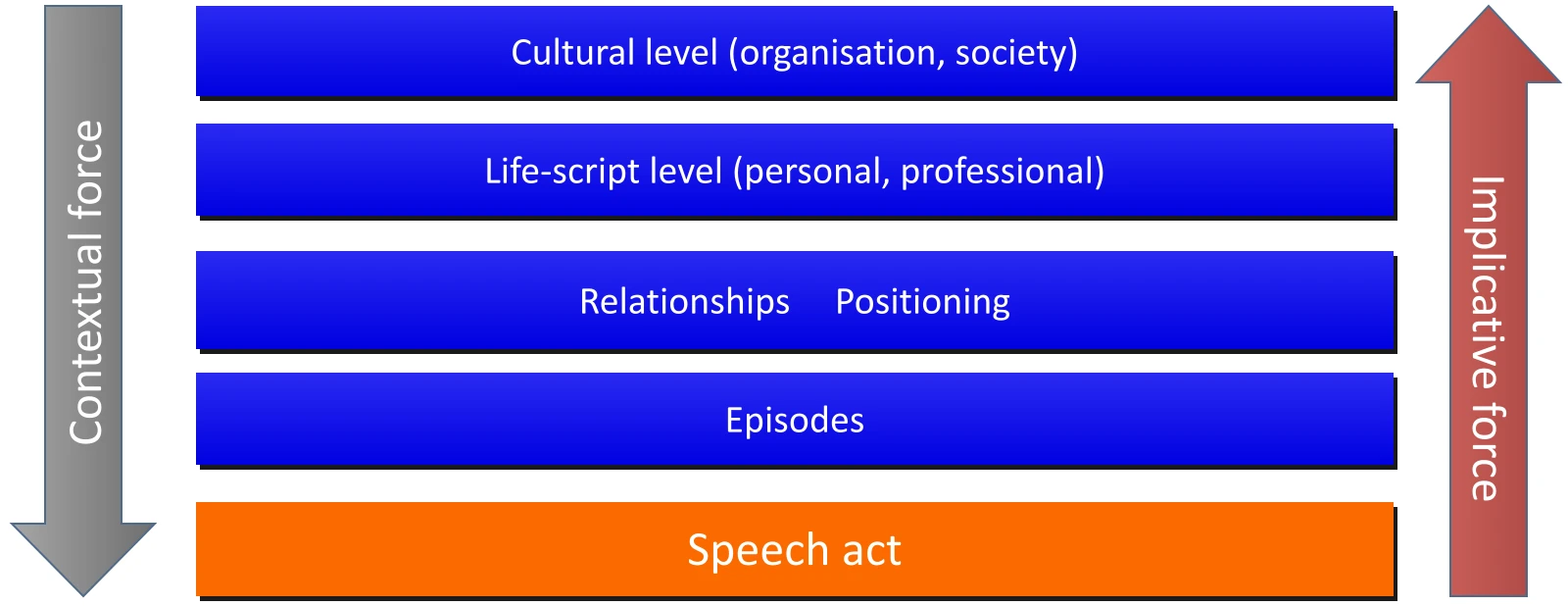
Relationships form part of the context, because the relationship we have to each other shapes our speech acts. Is it a boss–employee relationship, is it a relationship between equals, is it a family relationship, is it a customer–supplier relationship? Your speech acts to your spouse are of course not the same as when you talk with your employee or a customer.
Your life script is made up of everything you carry in your rucksack from earlier in your life, because for you it forms part of the context for your current speech acts. If, for example, you have bad experiences from the past with having to trust each other, then a current situation where you depend on another person can make you feel insecure. It can also be a professional experience, such as having good experiences with IBM, and so in a current purchasing decision you will be inclined to favour IBM in your communication with the others in management.
The level of culture covers the fact that the context for your speech act is also made up of, for example, values and ideas tied to the company culture where you work, or perhaps to the culture in society more broadly. As I write this, I have just read about a young man who was nominated for an award and who had his nomination withdrawn because he made sweeping and condescending remarks about foreign workers and refugees. The young man had apparently overlooked the broader context for his public statements, which his speech act did not fit into very well.
The figure above illustrates the different contextual frames that surround your speech acts. The connection between your speech acts and the contexts runs through a) the contextual force and b) the implicative force. The downward arrow with “the contextual force” tells us that a force from the various contexts works down on your communication. In other words, you adapt your speech act to the context. At least as interesting is “the implicative force” in the upward arrow, which illustrates that it is not only the contexts that control you and your speech acts. Through your speech acts you can influence and change the contexts around you. Of course it takes courage and strength not to be controlled by your surroundings, but instead to be the one who writes the story. In small ways it can be about daring to say “no” and to “answer back” when someone tries to put you in a box, for example by talking down to you. A colleague in the management team may be painting a picture of reality in which you are inferior to him and perhaps ought to report to him, but you manage to “man up” and “give as good as you get”, so that everyone understands that the picture of reality is that you are equals. There you used your implicative force, in response to the other person first trying to use his implicative force to talk you down. When the contextual force works on you, you adapt your speech acts to the situation. With the implicative force you go the other way; now it is you who creates the context that subsequently controls other people’s – and your own – speech acts. What could be other examples of using your implicative force to define the context? It could be a) you have a meeting with an employee and say “what I would like to talk to you about is your lack of performance”, b) at a department meeting you present a burning platform and say “after we lost XYZ Ltd as a customer our finances are under pressure, and if we are to avoid redundancies, we need to pull together” or c) you let your partner understand that you would like the two of you to have a child together or d) you tell an acquaintance that you have fallen in love with them. The four examples immediately define a new world and a new context, and so they are examples of how we humans are not only controlled by the contexts; we also create them ourselves, and then it is up to others to relate to the new framework. Reality has changed in an instant, and will never be quite the same again. Within social constructionism, reality is described as a social construction, and that is really what CMM is concerned with.
Comparing Robert Kegan and CMM theory
Similarities: It is very straightforward to relate Robert Kegan’s model of social maturity to CMM theory. The right-hand side of Kegan’s model, for example the socialised mind, focuses on “the needs of others”, and can be compared with the contextual force in CMM theory, where we are controlled by the contexts. The left-hand side of Kegan’s model focuses on “my independence”, and corresponds to the implicative force in CMM theory. Kegan even calls stage 4 the “self-authoring mind”, which indicates that it is a level with a good deal of implicative force.
What else does CMM give us as leaders? CMM gives us an analytical tool for communication in contexts, and we learn to understand communication as action – speech acts. If we once again link CMM and Kegan, we can say that CMM teaches us that Kegan’s social maturity is about maturing in the way we communicate with other people.
How can you as a leader use CMM in your own maturing process?
CMM makes you more aware of communication as action. The function of language is not only to name things. In addition, CMM gives you an awareness of the connection between a) your speech acts and b) the contexts you are part of. As a leader it is important that you are aware of the contextual force and understand how the situation affects your own and other people’s speech acts. And it is also important that you are aware of your own and others’ implicative force, and understand where you and others can shape and create the surrounding contexts through your own speech acts. As a leader you can train your ability to sense when others are shaping the context around you and your speech act, just as you can train your ability to sense that here you can break the context and create a new reality yourself through your speech act. When you work with these elements of CMM, you are at the same time supporting your own maturing process, as described by Robert Kegan. It is my view that if you are to use your implicative force constructively and in a balanced way in your speech acts, it is important that you also listen to the contextual force. Because otherwise you risk, with the best of intentions, barging through with your message, but without timing, empathy and a feel for the situation. My best advice to you as a leader is that when you use your implicative force, you must make sure that you are talking with the other person and not to them. Then you are well on your way.
It is with the self-transforming mind that you have the very best ability to communicate. Here you can really listen with your contextual force, without noise from your defences and your own plans, and you will know how to use your implicative force wisely and to good effect.
2c Maturana’s autopoietic system – on talking with each other
All living systems are closed, with a built-in ability to create and renew themselves. This is the essence of the concept of autopoiesis, which was introduced by the Chilean biologist Humberto Maturana and his student Francisco Varela.
To begin with, I will relate the concept of autopoiesis to leadership by noting that most leaders want to motivate and build a sense of community. The paradox is that you as a leader can only do this when you realise that all people are closed systems. There is literally a boundary between the person and the surrounding world, and in very concrete terms the boundary is the skin on the outside of the body.
You are one closed system, I am another, one of your employees is a third closed system and so on. In the following two sections I use the word “system” instead of the word “person”, to keep the reader’s attention on the fact that we are all closed systems.
Even though we are closed systems, no system survives without coupling itself to the surrounding world. When the system couples itself to its surroundings, it does so through the sensory organs on the outside of the system, namely eyes and ears. The eyes and ears sit at the interface between the system and the surrounding world, and make it possible for the otherwise closed system to orient itself in its surroundings. The system uses its eyes and ears selectively, in the sense that the system sees and hears actively when the system itself wants to, and the system even chooses for itself which parts of the surrounding world it zooms in on.
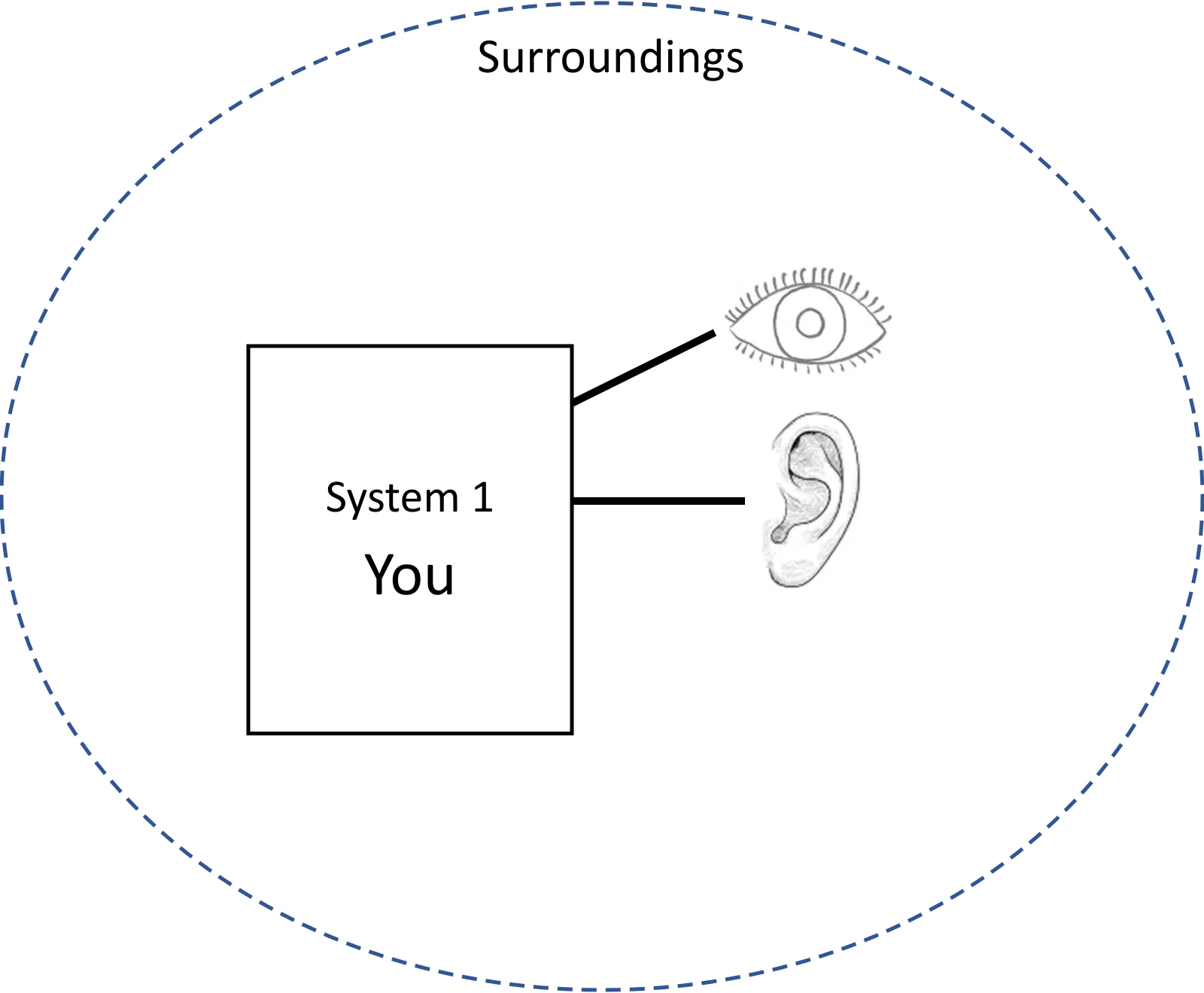
When the system takes in information from the surrounding world, it is interpreted on the basis of the system’s own previous experiences. Not only does the system itself control what it will observe out in its surroundings and how (which could be what the boss says to the system/you), but on top of that the system interprets the information in its own way. The system can also reflect on the interpreted information, and so learn something new. But it is the system itself that arrives at the learning on the basis of its own reflections.
The system turns its attention to something in the surrounding world when a so-called “appropriate perturbation” occurs. If the perturbation is too weak, the system does not notice it, and if it is too strong, the system shuts down and closes the shutters, so that no information is taken in at all.
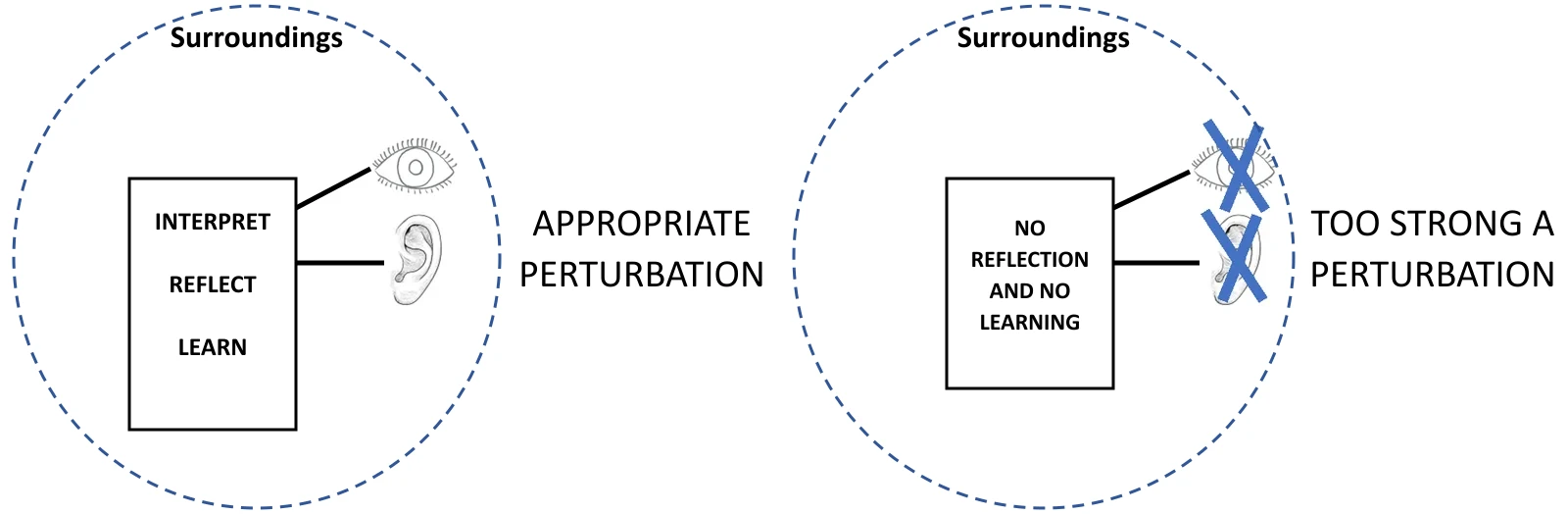
What does this mean in practice for you as a leader? It means that you as a leader in principle cannot teach your employee anything. Only your employee can teach themselves something new through their own reflection. You can talk with your employee, and through your communication present the employee with an appropriate perturbation, and then the employee will reflect and develop. Sometimes we leaders talk to our employees as if, figuratively speaking, we had drilled a hole in the top of the employee’s head and were pouring new knowledge into it through a funnel. That is exactly what happens when we talk to the employee: we believe we can send something from our own head over into the employee’s head. But we cannot, even if we try, because the leader is an independent and closed system and the employee is another independent and closed system. So we cannot send our own thoughts over into the employee’s head like a kind of radio signal. That is why we cannot talk to employees; instead we can try to talk with each other, and in the dialogue create a shared understanding of a topic. We cannot create a completely shared understanding, but through dialogue we can create something that comes close, and that makes collaboration possible.
It also means that we leaders have to focus on listening to our employees, because when we listen, we begin to get an understanding of the other person. We often think we know the employee, but very often it is just something we think. We may also say to our employees “well, you know me” – hmm, but they know you nowhere near as well as you think.
What I particularly like about Maturana’s description of the human being as an autopoietic system is that he shows it is a biological fact. We have to talk with each other, and not to each other, because that is how we humans are biologically. Many have talked about the importance of talking with each other, and not to each other, and many have talked about the importance of listening to each other. But often it has been presented as the author’s own conviction and ethical choice, and then some leaders will of course think “yes, but I am of a different conviction, I make a different choice”. Maturana shows that as leaders we have to adapt our communication to the fact that we are all closed systems, and this is a biological fact. If on that basis a leader says “I couldn’t care less about that, I’m the one in charge, and I will always dictate how I want things”; well, then in my view that leader is demonstrably incompetent as a leader.
Comparing Robert Kegan and Maturana’s autopoietic system
Similarities: Leaders on the left of Kegan’s model, i.e. stage 4, the self-authoring mind, often talk to other people and forget to create dialogue. This can make other people close the shutters on their autopoietic system. Leaders on the right of Kegan’s model, i.e. stage 3, the socialised mind, do not manage to create a safe framework for the interaction between people, because they lack natural authority and impact. So they do not get expectations clearly aligned, follow up, establish structures and set boundaries. The stage 3 leader talks with other people when the sun is shining and we are cycling downhill, but when there is conflict, the stage 3 leader does not talk at all, or talks shrilly to others. This can then make other people close the shutters on their autopoietic system, and suddenly we have “trench warfare”.
What else does Maturana’s autopoietic system give us as leaders?
The emphasis on “the perturbation” is constructive. If you talk too harshly to a stage 3 leader, the autopoietic system shuts down, because the perturbation was too big. If you do not communicate clearly to a stage 4 leader, he does not register that you are saying anything at all, because the perturbation is too vague.
When we leaders prepare to communicate with our employees, it is useful to consider: how do we create an appropriate perturbation?
How can you as a leader use autopoiesis in your own maturing process?
You are an autopoietic system yourself. When you are at stage 2 (the egocentric mind), you are a system that is very driven by needs; at stage 3 (the socialised mind) you are a more sensitive and insecure system, while at stage 4 (the self-authoring mind) you are a very consolidated system that keeps a steady course – sometimes almost too much so. You can think about how you couple yourself to the surrounding world; are you very sensitive, or do you seek to have confirmed what you know is right? You can think about how you interpret the surrounding world; how subjective are your interpretations, and how open are you to seeing the world as it is? And you can try to reflect and learn something new; can you change something in your inner map and your patterns of action?
I have the following advice for you: you should seek out and couple yourself to people who you sense can develop your system. If you follow this advice, you will often choose to couple yourself to people who are different from you, because they can perturb your system, but you should know that you can easily misunderstand each other, so the people you couple yourself to may choose to leave the collaboration. So look after the collaboration with the person who is different from you, because it can give your system a great deal of valuable learning.
On the whole, I think it is important that you seek appropriate perturbations of your own system. You have to dare to try something new, you have to get out of your comfort zone, so that you feel the world and so that your system moves. But remember, the perturbations must be appropriate. Help each other, look out for each other, and remember that as a leader there is an extra responsibility resting on your shoulders.
Literature
Changing on the Job, Second Edition – How Leaders Become Courageous, Wise, and Steady in an Anxious World. Jennifer Garvey Berger, 2024.
An Everyone Culture – Becoming a Deliberately Developmental Organization. Robert Kegan, Lisa Laskow Lahey, 2016.
Immunity to Change – How to Overcome it and Unlock the Potential in Yourself and Your Organization. Robert Kegan, Lisa Laskow Lahey, 2009.
How the Way We Talk Can Change the Way We Work – Seven Languages for Transformation. Robert Kegan, Lisa Laskow Lahey, 2003.
In Over Our Heads – The Mental Demands of Modern Life. Robert Kegan, 1998.
The Evolving Self – Problem and Process in Human Development. Robert Kegan, 1983.